

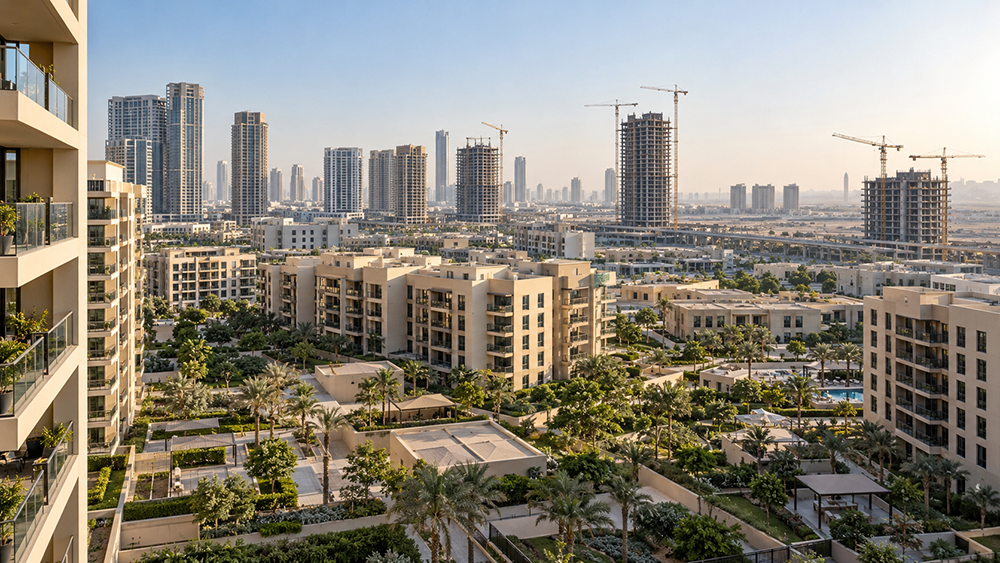
How many competing homes could be delivered near the Dubai property I am buying?
Start with registered projects around your target property, then compare their construction status, expected delivery dates and unit types. Separate scheduled completions from homes actually available to rent or buy. Assess the alternatives your future tenant or buyer would consider, and test your budget against lower rent and longer vacancy.
A citywide supply headline cannot tell you how much competition a particular apartment will face. A nearby tower may contain a different product, finish later or attract another budget. This Zellige Properties guide, checked on 29 October 2026, explains how to turn a broad concern about future housing into a practical property checklist.
What the latest research can and cannot establish
Savills’ report dated 12 October 2026 identifies more than 525,000 residential units scheduled for delivery between 2027 and 2030, while noting delayed completions. This is a published pipeline estimate, not a guaranteed delivery total or a count of homes that will all become rental listings.
Before comparing reports, check their observation dates, geographic boundaries, property categories and delivery periods. A figure for active construction is not automatically comparable with all announced projects. Do not combine different totals or average them to create a supposedly more accurate forecast. Preserve each source’s definition and explain what remains unknown.
Define the competition from the customer’s perspective
Write down the property you are evaluating: bedroom count, usable area, condition, furnishing, parking, expected annual rent and likely occupant. A household seeking a three-bedroom villa may not consider the studios across the road. Conversely, similar apartments in an adjacent community can compete even if a map puts them outside your chosen district.
Build a shortlist of realistic alternatives using journey times, access to work, schools and amenities. Use a map radius as an initial search aid, not an economic boundary. Note construction disturbance separately: a project can affect noise and access even when its homes are not close substitutes for yours.
Check official project records
DLD’s Project Status Enquiry supports searches by project name or number, and Dubai REST provides Project Status (Mashrooi). The service presents fields for project details, units, completion information and updates. Match the registered project and phase to the development being marketed; a similar commercial name is not enough.
Record what is actually displayed, including the observation date, and mark unavailable information as unknown. A blank field does not mean zero units. If official information and a developer’s dated update differ, retain both and request an explanation. Do not silently replace an older record with an unsupported sales message.
Construction percentages are useful observations, but they are not a countdown clock. Do not convert 80% completion into a claim that only 20% of the time remains. Distinguish physical construction, completion documentation, handover and actual availability for occupation. Ask which event each date describes.
Create a project-by-project comparison
Use one row for each identifiable project or phase. Avoid counting a master development and its individual towers twice. A useful working sheet records the following:
| Field | Question it answers |
|---|---|
| Registered name and project number | Am I tracking the correct development? |
| Location and phase | Does it compete with this specific property? |
| Unit count and bedroom mix | How many homes could be genuine substitutes? |
| Construction observation and date | How recent is the progress evidence? |
| Expected completion and source | Which delivery window is being suggested? |
| Rent, size and specification | Would the same customer consider it? |
| Uncertainty and next check | What must be verified before relying on it? |
Separate facts from assumptions within each row. For example, an official total unit count does not reveal the number of one-bedroom homes unless the mix is available. Ask for the relevant schedule rather than multiplying by a guessed percentage and presenting the result as verified supply.
Use delivery windows, not one certain date
Organise the shortlist into the next twelve months, the following twelve months and later periods. These are planning windows, not official classifications. Keep undated projects in an unknown category. Review the picture again before reservation, before a major payment decision and before your intended letting or resale.
Then build scenarios: delivery follows the documented programme, some projects move later, or more competing homes become available together than expected. A delay can reduce immediate competition while shifting it into your eventual letting period. It does not automatically remove the future competitive risk.
Illustration: 1,200 nearby units are not 1,200 direct rivals
Imagine three fictional nearby projects with 600, 400 and 200 homes. Assume their documented one-bedroom counts are 240, 160 and 40. The total is 1,200 homes, of which 440 are one-bedroom units. If the third project belongs to a later delivery window, the first window contains 400 comparable one-bedroom units.
This is arithmetic for an invented example, not data for a named Dubai community. Even the 400 figure is not a forecast of rental listings: some buyers may occupy their homes, some units may be offered for sale, and letting dates may differ. Without evidence, do not invent an investor-owned share or claim all units will launch together.
Compare supply with actual market activity
DLD’s Real Estate Data service separates transactions, rents and project information and provides filtering options. Use comparable locations, periods and property types. A sale registration measures a transaction; it does not by itself establish occupancy or a new household moving into the area.
For your own analysis, distinguish new leases from renewals where the dataset allows. Renewals demonstrate continuing tenancy, not necessarily absorption of an additional vacant home. Likewise, listings can be duplicated, stale or withdrawn. A count of advertisements cannot be assumed to equal unique available units.
Track asking rents alongside verified signed-rent evidence, dated availability and concessions. If one landlord offers a rent-free period, compare the effective annual package rather than the headline alone. Do not turn citywide population growth into a one-for-one requirement for homes: household size, affordability and accommodation choices matter.
Stress-test rent and vacancy together
Consider a hypothetical annual rent of AED 100,000 and fixed annual ownership costs of AED 20,000. With full occupancy, income after these costs is AED 80,000. Assume a stress case of 10% lower rent and two vacant months: AED 90,000 × 10 ÷ 12 gives AED 75,000 collected, leaving AED 55,000 after costs.
The reduction is AED 25,000, or 31.25% of the original AED 80,000. This is an illustrative sensitivity test, not a forecast or net-yield calculation. It excludes financing, purchase and sale costs, taxes where applicable, and exceptional repairs. Fixed costs are assumed unchanged; replace every input with property-specific figures.
When reviewing alternatives with Zellige Properties, ask which assumptions drive the result. A decision that works only with immediate occupancy and rising rent deserves closer examination. For an owner-occupier, consider future resale competition as well as day-to-day suitability; you do not need a rental-income model to assess every purchase.
Frequently asked questions
Does a large pipeline prove prices will fall?
No. Timing, competing stock, affordability and demand all matter. A pipeline identifies something to investigate; it does not determine a particular property’s future price.
Does a sold-out project stop being future supply?
No. Developer sales and eventual use are different questions. Sold homes can later compete through resale or letting, or be occupied by their owners.
What if my own handover is delayed?
That raises a separate contractual issue. Consult our guide to delayed off-plan handovers and buyer options; a supply analysis does not establish rights to suspend payments or cancel.
Make the next decision specific
Before committing, identify your closest competing projects, the evidence behind their timing and the financial scenario you can tolerate. For help comparing a shortlist, contact Zellige Properties with the property, budget, intended use and holding period. Ask for documented comparisons rather than a citywide reassurance.
General information only, not investment, financial or legal advice. Pipeline estimates may change. All numerical examples are hypothetical and do not predict prices, rents or delivery dates.
Sources
- Savills — Dubai Residential Market Report, Q3 2026 (12 October 2026)
- DLD — Project Status Enquiry
- DLD — Dubai REST and Project Status guidance
- DLD — Real Estate Data
Interested in Dubai Real Estate Opportunities?
Connect directly for confidential market insights, bespoke property selections, and direct-to-owner opportunities in Dubai.